
Attorney Shoba Jaglal brings more than 32 years of experience in the legal field to every case. Our office has achieved a 98% success rate, reflecting our commitment to helping clients achieve their immigration goals. Having personally navigated the U.S. immigration process, Attorney Jaglal understands what her clients are going through. We intentionally maintain a boutique practice to provide individualized attention, clear communication, and dedicated support.Why Hire Our Palm Bay Family Immigration Attorney?

32+ Years of Legal Experience

98% Case Success Rate

Lived the Immigration Process

Personalized, Boutique Representation
Your spouse is waiting in another country. Your mother is getting older and you want her here, not on a video call. Your brother has asked, for the third time, whether there is any way for us to be close to each other. Family immigration is the legal answer to those situations, and in Palm Bay it runs through one office where the attorney who founded it reads your file herself.
Shoba Jaglal founded Jag Law, PLLC, around keeping families together. Our Palm Bay immigration attorney handles marriage-based green cards, fiancé(e) visas, and parent, child, and sibling petitions for U.S. citizens and permanent residents. If you are a citizen or a lawful permanent resident and you want to bring a relative here to live, you will be the sponsor: you file the petition, you prove the relationship, and in most cases you sign an Affidavit of Support that makes you financially responsible for them after they arrive. What makes it hard is the paperwork, the category your relative falls into, and the years some categories take. Our job is to carry that part for you.
Call (321) 451-4210 now and tell us who you want to bring, or ask for a case evaluation. Consultations available in English and Spanish.
Why Families In Palm Bay Choose Jag Law
Family sponsorship is a common route to a green card in the United States. Mistakes in eligibility, documentation, or filing can cause significant delays.
What our family-based immigration lawyer in Palm Bay does for you:
Much of that work happens over years rather than weeks, which is why who holds your file matters as much as who files it.
Two things decide everything that follows: whether you are a U.S. citizen or a permanent resident, and how you are related to the person you want to bring to the United States.
The law splits family petitions into two groups. Immediate relatives of U.S. citizens have no annual limit, so no visa wait time exists. Everyone else falls into a preference category, where only a specific set number of visas are issued each year, and a wait is built in.
| Group | Who It Covers | Annual Limit |
|---|---|---|
| Immediate relative | Spouse (IR-1), unmarried child under 21 (IR-2), or parent (IR-5) of a U.S. citizen | None |
| F1 | Unmarried adult son or daughter of a U.S. citizen | 23,400 |
| F2A | Spouse or unmarried child under 21 of a permanent resident | 77% of the 114,200 F2 total |
| F2B | Unmarried adult son or daughter of a permanent resident | The remaining 23% of the F2 total |
| F3 | Married son or daughter of a U.S. citizen | 23,400 |
| F4 | Brother or sister of a U.S. citizen | 65,000 |
In a preference category, your relative’s spouse and unmarried children under 21 can usually come with them as derivatives on the same petition. Immediate relative categories have no derivatives, so each person needs a petition of their own.
Four conditions inside that table cause most of the confusion:
Spousal petitions are decided without regard to whether the spouses are of the same or different sex. USCIS has approved them since July 2013, following United States v. Windsor. A marriage is judged by the law of the place where it was celebrated, which is the rule that matters if you married outside the United States.
Not sure which row you are in? Call (321) 451-4210 and we will place your relative in a category on the first call.
Family immigration covers several related processes, and we provide the following services for family members looking to sponsor their relatives:
Most family immigration cases involve filing a petition, determining visa availability, and applying for permanent residence. Fiancé(e) visas and a few other family processes follow their own procedures, but for the sponsorship cases this page covers, what differs from family to family is mainly how long the wait for a visa number takes.
Form I-130, Petition for Alien Relative, is not an application for a green card. It asks the government to recognize your relationship, and it is decided on documents rather than argument. You will need:
Missing or inconsistent evidence can delay a petition or result in a denial. Getting the file right before it goes out is cheaper than fixing it after.
Immediate relatives skip this stage. There is no visa wait time for them, and the case moves straight to stage three.
Preference categories do have wait times for visas, and this is where families are most often misinformed. Two separate caps apply at the same time:
The country cap is applied to the country of birth. Not citizenship, and not where anyone lives now. Two identical petitions move at different speeds when the beneficiaries were born in different countries, and nothing about your family or your paperwork changes that.
How the visa wait time works in practice. Your petition takes a priority date on the day USCIS receives it, and that date is your place in line. An earlier priority date means an earlier place, which is why filing the day you become eligible matters more than filing the day you feel ready. Each month the State Department publishes a Visa Bulletin with two charts for every category and country. The Final Action Dates chart shows which priority dates can be approved that month. The Dates for Filing chart, which usually runs ahead of it, shows which priority dates may submit the green card application early so the paperwork is ready when a visa becomes available. USCIS announces each month which chart it will honor for adjustment applications.
Two points that surprise most clients. The cut-off dates can move backward. When a category is oversubscribed, the date retrogresses rather than simply pausing, and a case that was current one month can stop being current the next. And, being allowed to file under the Dates for Filing chart does not mean the green card is close. It cannot be approved until the priority date clears the Final Action Date.
We do not publish current cut-off dates on this page. They change monthly, and a page that quotes one may be wrong within weeks.
When a visa is available, your relative becomes a permanent resident in one of two ways.
| Comparison point | Adjustment of Status | Consular Processing |
|---|---|---|
| Where the case finishes | Inside the United States, on Form I-485 | At a U.S. embassy or consulate abroad, through the National Visa Center |
| Basic threshold | Your relative was inspected and admitted or paroled into the United States, and is physically here | Your relative is outside the United States, or is not eligible to adjust |
| Who decides it | USCIS | A consular officer |
Admission or parole is the threshold for adjustment, but it is not the whole test. USCIS also looks at whether a visa is available at filing and again at decision, whether your relative is admissible or eligible for a waiver, and whether any of the statutory bars to adjustment apply, such as unauthorized work or a lapse in status. Immediate relatives of U.S. citizens are exempt from most of those bars, and a limited group of applicants with older petitions can adjust under INA 245(i) even after an entry without inspection. The route is not a preference. It turns on your relative’s immigration history, sometimes going back years, and choosing wrongly is one of the few mistakes here that is hard to undo.
Before you assume a consulate is the simpler option, read the next two sections. Leaving the United States is exactly what triggers the bars described below.
Filing the I-130 petition does not by itself make you financially responsible for anyone. That responsibility comes from Form I-864, Affidavit of Support, which most family-based green card applicants must file with their case, and it becomes enforceable when your relative is granted permanent residence. Sponsoring through the I-864 is a financial undertaking, and it lasts longer than most people are told. Two different tests sit under the same 125 percent figure, and they are constantly confused:
Under the governing statute and regulations, the obligation ends when the person you sponsored becomes a U.S. citizen, is credited with 40 qualifying quarters of Social Security coverage, loses permanent resident status and leaves the United States, is granted a new adjustment of status in removal proceedings, or dies. It also ends if you die, though anything owed before that remains enforceable against your estate.
Three things follow that clients are rarely warned about:
The dollar figure moves every year with the poverty guidelines, so we work from the current Form I-864P table rather than a number printed on a website.
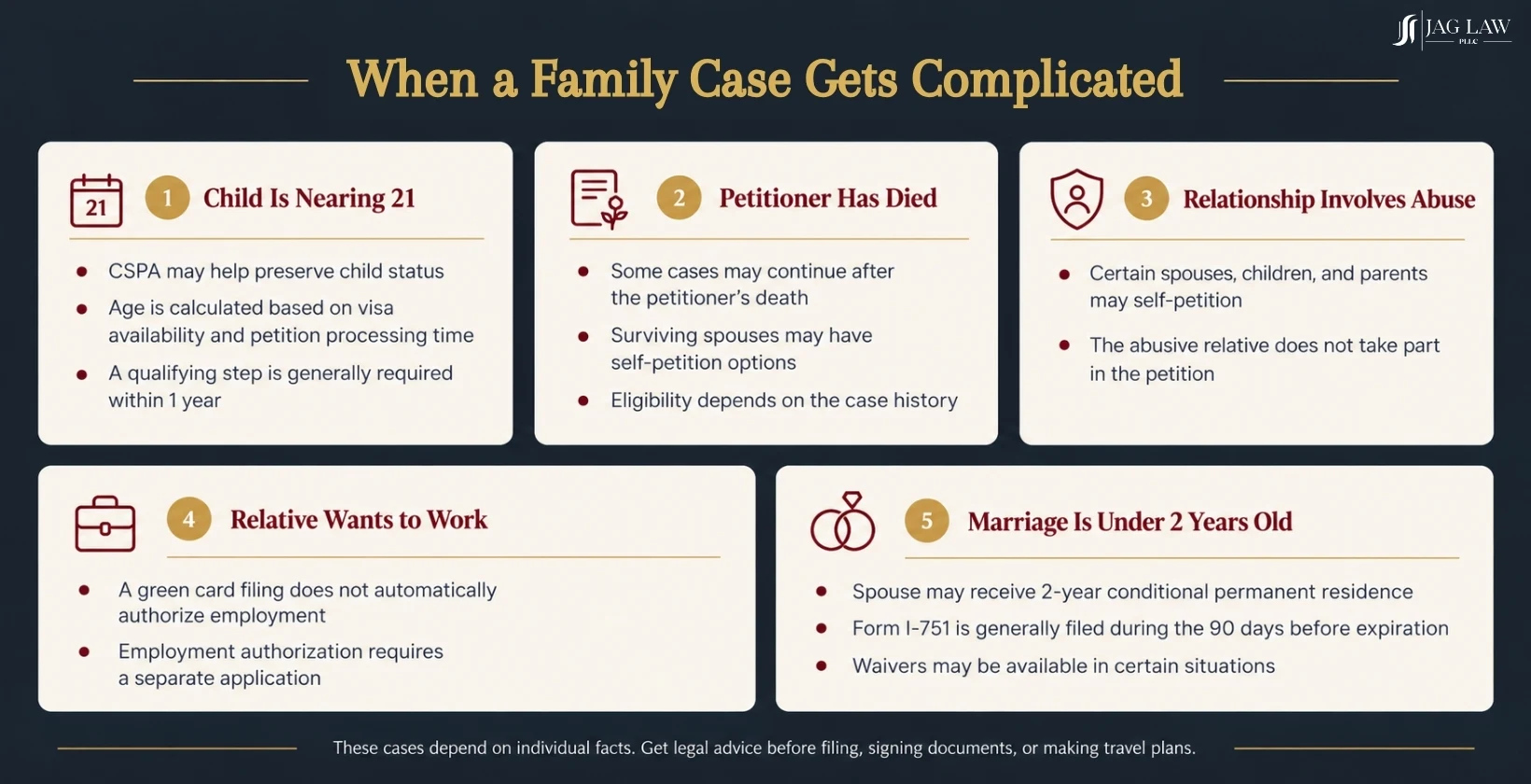
Most family cases are one of the rows in the table above. These are not. If any of them describes your family, get advice before you file anything, sign anything, or book a flight. The rules below depend heavily on the specific facts and the case history, so treat them as a reason to call, not as an answer.
If your relative is in the United States without status, understand this before anyone travels: the departure triggers the bar, not the unlawful presence itself. A case can be going well right up until someone gets on a plane.
| Unlawful Presence Before Leaving | Bar On Returning |
|---|---|
| More than 180 days, less than one year | 3 years |
| One year or more | 10 years |
Do not apply this table to yourself without a review of your relative’s full immigration history. Not every period without lawful status counts as unlawful presence: time spent under 18, time with a pending asylum application, and certain other periods are excluded, and exceptions and waivers may apply. A waiver exists, and its wording is what decides these cases. It requires extreme hardship to a U.S. citizen or permanent resident spouse or parent of the person seeking it. Hardship to a child is not the statutory test.
Any one of these is a reason to call before doing anything on your own. Dial (321) 451-4210 now.
No. Immediate relatives are defined only in relation to a U.S. citizen who is at least 21, and parents sit in that group. A permanent resident may petition for a spouse or an unmarried child. If you are eligible to naturalize, becoming a citizen is how you open a parent petition. You must be a citizen and at least 21.
An immediate relative case takes as long as processing takes, because no visa wait time applies. A preference case takes as long as the visa takes to become available, and the wait is determined by two facts: the visa category and in some cases, your relative’s country of birth. The State Department publishes the current position every month in the Visa Bulletin.
Legal fees and government filing fees are two separate costs. USCIS sets the filing fees and revises them periodically, so we quote the applicable fee at the time of filing. Legal fees depend on the category and on what the case involves such as a prior refusal, a waiver, or a child close to 21. You will have both numbers before you decide anything.
No. No attorney can guarantee the outcome of an immigration case. Approval rests on the facts and on an officer’s decision, neither of which any lawyer controls. What a lawyer controls is whether the category is right, whether the evidence is complete, and whether a problem in the record was dealt with before filing rather than after. A thoroughly prepared file provides a higher chance of approval.
Their current immigration status decides it, not the pending petition. A petition does not grant permission to be here, and it does not protect anyone who is out of status. Read the unlawful presence section above before making any plan that involves staying or leaving. These are complex issues and require a thorough legal analysis.
The denial notice states the reason for the denial along with other pertinent information. A denied I-130 can be appealed to the Board of Immigration Appeals (BIA) on Form EOIR-29, filed with the USCIS office that issued the denial, generally within 30 days. If new evidence has surfaced or the officer misread the record, a motion to reopen or reconsider may be filed through Form I-290B. This is filed with USCIS. In some cases a corrected re-filing is faster than either. The deadline and the remedies available in your case must be confirmed from the actual denial notice, since they vary by petition type and by the office that decided it. A Notice of Intent to Deny is different: it provides an opportunity to respond before a final decision is made. Reading the notice against the record is the first step, and it is worth doing before making any decision about what comes next. Consulting with an experienced immigration attorney is key.
No. Many families file without one, and plenty of those are fine. The ones that go wrong tend to go wrong in the same four ways: the wrong form, missing evidence, a rule that changed, or eligibility misunderstood at the start. Preventing those errors before filing is cheaper than catching them at an interview or in a denial notice. It often results in spending more money to rectify and most importantly, a loss of critical time in obtaining status.

A family case can take years. We take that seriously.
Tell us who you want to bring, and in one conversation we will place them in a category, say whether a visa wait time applies, and explain the process in detail. If you would rather do that across a desk, our office is in Palm Bay, and the door is open.
Call (321) 451-4210 or ask for a case evaluation. Consultations in English or Spanish.
Prior results do not guarantee a similar outcome. Every case is unique, and the outcome of any immigration matter depends on its specific facts.


