

Attorney Shoba Jaglal brings more than 32 years of experience in the legal field to every case.

Our office has achieved a 98% success rate, reflecting our commitment to helping clients achieve their immigration goals.

Having personally navigated the U.S. immigration process, Attorney Jaglal understands what her clients are going through.

We intentionally maintain a boutique practice to provide individualized attention, clear communication, and dedicated support.
Waiting on a visa decision reshapes a family’s entire timeline: a wedding on hold, a job offer with an expiration date, or a child’s school year hanging on a visa appointment. In Palm Bay, FL, where about one in six residents was born outside the U.S., many families are in the middle of a petition, a renewal, or a visa interview. If yours is one of them, you need to know it’s being handled correctly.
At Jag Law, PLLC, lead attorney Shoba Jaglal personally reviews every visa petition, supporting document, and evidence package before submission to catch errors before USCIS does. Whether you are petitioning for a spouse, securing a high-skilled work visa, applying for a student visa, or filing an investor petition, our office delivers direct attorney representation from your first filing through your interview and final decision.
Call (321) 451-4210 to schedule a consultation or request a case evaluation online. Our immigration lawyer in Palm Bay will review your timeline, current immigration status, and visa options with you.
What Working With Our Palm Bay Office Looks Like
In U.S. immigration law, visas fall into two main categories: nonimmigrant visas for temporary stays and immigrant visas that lead to permanent residency (a green card). As a Palm Bay immigration lawyer, Attorney Jaglal handles the following visa pathways for individuals, families, and businesses across Brevard County.
Family and Fiancé Visas U.S. citizens can sponsor a fiancé through a K-1 visa or petition for a spouse, parent, or child as an Immediate Relative (IR), and both citizens and permanent residents can petition for other eligible relatives through the Family Preference (F) categories. We handle the petition, proof of your relationship, and interview preparation. Learn more -> Palm Bay family immigration lawyer | Work and Employment Visas Employers can sponsor foreign national workers, and professionals with a U.S. job offer or intracompany transfer can secure temporary authorization through H-1B, L-1, O-1, E-1/E-2, E-3, TN, or H-2A/H-2B visas. We handle the employer petition, supporting documentation, and the path from temporary status to a green card. Learn more -> Palm Bay employment-based immigration lawyer |
Student Visas International students accepted into SEVP-certified institutions can pursue academic programs on an F-1 visa or vocational training on an M-1 visa. We handle your documents, consular interview preparation, and status maintenance while you study. Learn more -> Palm Bay student visa lawyer | Investor and Self-Petition Visas Investors can pursue a green card through the EB-5 program (with minimum investments of $800,000 in a Targeted Employment Area or $1,050,000 elsewhere). Professionals with advanced degrees or exceptional ability can self-petition without an employer sponsor through an EB-2 National Interest Waiver (NIW). We handle the petition and the evidence that supports it. |
Our visa lawyer also represents individuals seeking humanitarian protection, including U visa applicants (crime victims assisting law enforcement) and survivors of abuse filing VAWA self-petitions.
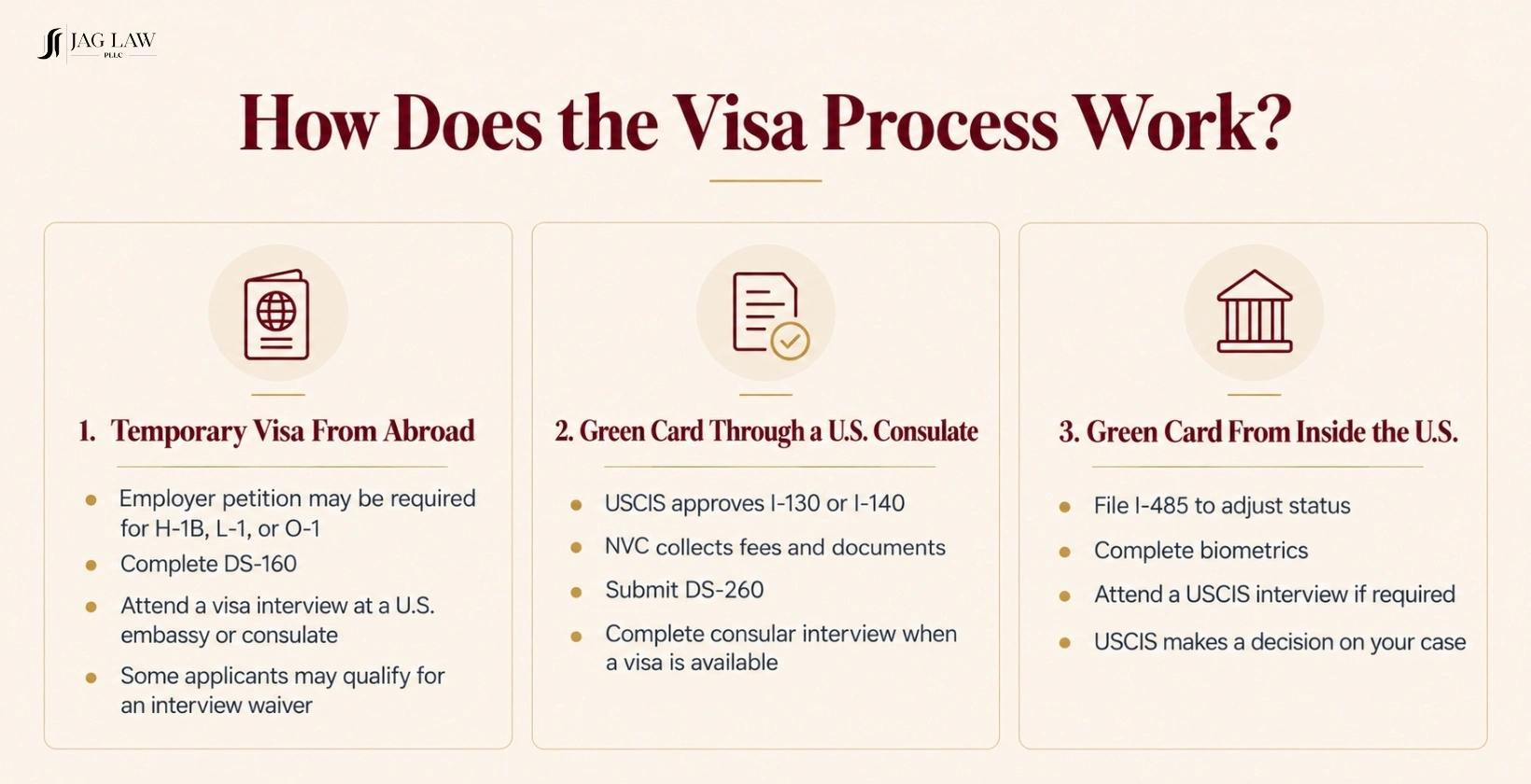
Your specific pathway depends on two things: whether you are seeking a temporary stay or permanent residence, and whether you are applying from abroad or from inside the United States. Most cases follow one of three primary routes:
At any stage, USCIS may issue a Request for Evidence. A consulate may instead refuse the visa under INA 221(g) pending missing documents or administrative processing. We prepare you for each stage, including the visa interview, so an unexpected notice doesn’t catch you off guard.
Not sure which path applies? Schedule a consultation to meet with Attorney Jaglal in person at our Palm Bay office. Hablamos español.
A Request for Evidence (RFE) means USCIS needs additional documentation before deciding your case. It isn’t a denial, but the deadline printed on the notice is strict, and a missed deadline usually ends in denial. When an RFE lands on our desk, we read it the same day and calendar the deadline immediately, not the week it’s due.
A delay is different: your case has simply moved outside the normal processing window with no request pending. We file a case inquiry with USCIS or the National Visa Center (NVC) first. If the delay remains unreasonable after that, mandamus litigation under 28 U.S.C. § 1361, often paired with a claim under the Administrative Procedure Act, asks a judge to compel a decision, though it does not guarantee approval.
Received an RFE, or has your case gone quiet? Call (321) 451-4210 with the notice or your receipt number in hand, and we’ll tell you where things stand and what to do next.
A denial or refusal is not always the final answer, but taking the wrong step, or taking action too late, can affect your immigration history. The next step depends on who denied your case, USCIS or a U.S. consulate, which benefit was denied, and why.
We start by reading the denial notice. It states the grounds for the decision, whether the decision can be appealed, and the deadline that applies. The grounds typically fall into one of three categories:
Not every USCIS decision can be appealed, and the deadlines for appeals and motions vary by filing type. Both must be confirmed from the actual denial notice, and missing the stated deadline usually forecloses that remedy.
A consular refusal works differently. There is generally no formal appeal, and courts generally cannot review a consular officer’s decision. A refusal under INA 221(g) is a refusal that may be overcome: the officer either needs specific documents, which you can submit, or has placed the case in administrative processing, which you wait out. Refusals on other grounds depend on the ground stated. Some can be addressed by reapplying with evidence that answers the officer’s concern; some inadmissibility findings may be eligible for an immigration waiver; and some cannot be overcome at all. Reading the refusal letter and the section of law it cites is the first step.
We identify the right forum and strategy before we file anything. If you received a denial or refusal notice, call (321) 451-4210 to discuss your options.
Every visa case is different, and our approach reflects that: Attorney Shoba Jaglal builds your strategy around your specific facts, not a standard template.
While no federal law requires an attorney to file a visa application, professional review can be beneficial. Errors in form selection, evidence, or category classification are common reasons for delay or denial. An immigration attorney can prevent these issues before submission, when they’re still easy to fix.
It depends on the visa category and case complexity since a fiancé petition and a contested employment case require different amounts of attorney work. We quote a specific fee during your consultation, so you know the cost before you commit.
Yes, a previous denial does not bar a new application in most cases. We review the stated grounds for the earlier denial or refusal first, since filing again without addressing the original problem usually produces the same result. A documentary gap is often easier to overcome than a discretionary finding.
Three different dates are often confused here. The expiration date on the visa stamp is only the last day you can use it to seek entry; it does not control how long you may stay. Your authorized period of stay is generally set by the I-94 admission record issued when you entered, subject to special rules for some categories, such as students admitted for “duration of status.” Staying past the I-94 date generally means you are out of status, and time in the United States after that date generally counts as unlawful presence, although some periods are excluded by law and the rules for certain categories differ. Under INA 212(a)(9)(B), a person who accrues more than 180 days but less than one year of unlawful presence and then departs is generally barred from returning for 3 years; one year or more, followed by departure, generally triggers a 10-year bar. The bars arise on departure, exceptions may apply, and waivers are available in some cases. Whether you need to leave and apply for a new visa, or have another option from inside the United States, depends on your immigration history, so get advice before you travel.
No, you don’t need to live in Palm Bay to work with our firm. Clients near Palm Bay meet with us in person at our office; clients farther away work with us remotely, with the same direct attorney review either way. Immigration law is federal, so representation isn’t limited to Brevard County.
It varies by category. Immediate relatives of U.S. citizens have no annual cap, so their wait is mainly USCIS and consular processing time. Preference categories also wait for a visa number, which can take years depending on the category and country. Check current USCIS processing times and the Visa Bulletin for your category.
Conquering the American dream. Fighting for justice.
Call (321) 451-4210 to talk through your visa category with Attorney Jaglal, or schedule a consultation and tell us where you are in the process. We respond in English or Spanish, and we’ll tell you what your case needs before you commit to anything.
Jag Law, PLLC | 4670 Lipscomb St. NE, Suite 1, Palm Bay, FL 32905
Every case is unique, and the outcome of any immigration matter depends on its specific facts. The information on this page is general and does not create an attorney-client relationship. Contact us to discuss your situation.


